Thursday, 8 May 2008

Bunny Bunny Day

HI. Still here in the Lake District with Beth. Another sunny beautiful day! What Luck! One of the things Beth and I like about our trips is that for the most part they are unstructured. We play it pretty loose with the itinerary. Yesterday, we did the one thing that I really wanted to do and that was visit Hill Top – the Lake District home of Beatrix Potter. I can’t say that I am a big fan of Peter Rabbit but Beatrix Potter was always a woman I admired. Like Jane Austen they pursued their passions living a bit beyond the prescribed rules of accepted societal norms.

Two high lights were garden where Peter surely lived and to see the desk where she sat and wrote looking at the same window view she did. Helen Beatrix Potter was born on 28 July 1866 into a privileged household in South Kensington and educated by governesses. Her family spent their holiday time in Scotland and the Lake District. It was during these trips that she grew to love nature. observing and painting what she saw. Beatrix is best remembered for her Peter Rabbit tales but she was a highly respected authority in the field of mycology through her study and paintings of fungi.

It wasn’t until her thirties did the highly successful children's book The Tale of Peter Rabbit getting published. In all toll, Potter published 23 children's books. She became secretly engaged to her publisher Norman Warne causing a breach with her parents, who disapproved of his social status. He was a tradesman! Sadly, Warne died before the wedding could take place.
Through the success of her books she was able to buy Hill Top farm in the Lake District. Beatrix became a sheep breeder and farmer while continuing to write and illustrate children's books. Protecting and preserving the Lake District was very important to her. and she continued to add to her land holdings throughout her life keeping the developers at bay. She did marry at the age of 47 a local solicitor named William Heelis. Beatrix Potter died on 22 December 1943 leaving almost all of her property to The National Trust.

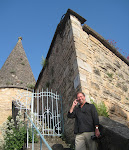
Beth and I had to chuckle as we were leaving to see a man hard at work in the garden – wondering if he were the new Mr. Macgregor!

Wednesday, 7 May 2008

Lake Windermere

Beth and I had a lovely day on the Lake. We cruised up to Ambleside for a really nice lakeside lunch. Yep, that was about it. It was a bright sunny day, we got a little sunburned on the face, sat on the terrace of the Old England Hotel having a late afternoon drink, went to dinner and then to bed.


Tuesday, 6 May 2008

Cinco de Mayo in Manchester

Ok, for those who don’t know the translation it is the 5th of May. Cinco de Mayo is a regional holiday in Mexico, probably a much bigger deal in the USA. What is supposed to be a fun day. The holiday commemorates a victory of Mexican forces led by General Ignacio Zaragoza Seguín over French forces in the Battle of Puebla on May 5, 1862. Cinco de Mayo is not Mexico's Independence Day (which is actually September 16). The date is observed as a celebration of Mexican heritage and pride (as it should be!). The celebrations combine food, music and dancing in honoring the culture of Americans of Mexican ancestry, much as St. Patrick's Day, Oktoberfest, and the Chinese New Year do for their respective ethnic groups.

So here were Beth and I at the Hard Rock Café on Cinco de Mayo in Manchester drinking god awful margaritas and eating $125 hamburgers (I swear the bill with tip was 65 pounds - one starter, two drinks and the two burgers!) The service was glacial, there was little food left on the menu (who runs out of spinach?), the Mexican music band pretty bad and somehow it was funny to us. Who knew there were so many Mexicans in Manchester? Imagine a Mexican accent with a Manchurian twists!

This could mean only one thing - today was the first day of the annual mother-daughter trip. We left London around 11:30 am and traveled as far as Stoke on Trent before we made a stop. It was either go through the traffic of Birmingham or take the easier route through Stoke. We opted for easy though Beth didn’t really opt for a bit of shopping. It felt un natural to travel past Wedgwood. Staffordshire, Hartley – Green and the other factories but we only made two stops. The Portmerion on the London Road and Spode. Portmerion by the way was having a tent sale –last day however! Beth was indoctrinated into the sisterhood of Stoke shoppers. She wasn’t impressed but at least she now understands!

We eventually joined the M6 motorway and headed north; planning on spending the night in Warrington before continuing on into the Lake District the next morning. One of the first things we saw while driving on the M6 was a large herd of cows on an overpass crossing the M6. I can’t tell you how odd this looked to our city eyes. 8 lanes of traffic, huge tractor trailers and some black and white cows! I just know that these cows have to go into the title of this trip somehow.

We checked into the rather dowdy Paddington House Hotel with rooms overlooking the car park and went in search of the Hard Rock Café in Manchester. It is some sort of ill defined family tradition to go to HRC’s while traveling. We still laugh about a Thanksgiving dinner spent at a HRC in Rome. I actually have quite a collection of European guitar pins.

Anyway, after some directional difficulties we actually found the Manchester HRC. THE directions we had made no sense and we finally managed just stumble on to it. (We did get to see Old Trafford stadium and the local version of the London eye though!). I paid some guy a pound to protect my car in a parking lot and off we went to Cinco de Mayo!

Wednesday, 30 April 2008

Walpurgis Night

Walpurgis Night is a holiday celebrated on April 30 or May 1, in large parts of Central and Northern Europe. The festival is named after Saint Walpurga, born in Wessex in 710 and died on 25 February 779. Historically the Walpurgisnacht is derived from pagan spring customs. In the Norse tradition, Walpurgisnacht is considered the "Enclosure of the Fallen". It commemorates the time when Odin died to retrieve the knowledge of the runes, and the night is said to be a time of weakness between the living and the dead. Bonfires were built to keep away the dead and chaotic spirits that were said to walk among the living then this is followed by the return of light and the sun as celebrated during May Day. Due to Walpurga's holy day falling on the same day, her name became associated with the celebrations. Early Christianity had a policy of 'Christianizing' pagan festivals so it is no accident that St. Walpurga's day was set to May 1st. The closing sequence of Fantasia, Night on Bald Mountain / Ave Maria is intended to portray Walpurgisnacht and not Halloween.

Tuesday, 29 April 2008

Whirligig of Oratory.

The following article appeared on line today in The New York Times This Date in History. I thought it was an interesting bit of history in light of my recent trip to Northern Ireland. I have always been fascinated by Irish-American financial support in Ireland. I sometimes think that a lot of Americans don't understand the situation in Ireland. One of the most surprising things about the Belfast Tour was being told point blank - that the troubles are not over!

"The Tall Sycamore of the Wabash in His Whirligig of Oratory.

"The Senate gave him full swing, and he handled the British Lion in a masterly way."--Washington News.

Artist: Thomas Nast

his Harper's Weekly cartoon by Thomas Nast presents Senate firebrand Daniel Voorhees of Indiana whirling the British Lion by its tail over the issue of Irish-Americans arrested by the British police.

The relations between the United States and Great Britain fluctuated over the nineteenth century. A low point came during the Civil War, when British shipbuilders outfitted Confederate warships and the Union feared the British government would formally recognize the Confederacy (they did not). Relations began to improve after the Treaty of Washington (1871) resolved outstanding issues from the war, but there were still occasional disputes.

One of the most serious controversies arose in the early 1880s over American support of Irish nationalists. During the Land War (1879-1882), angry tenant farmers in Ireland boycotted and protested against their British landlords and government officials. In reaction, the British Parliament enacted a temporary Coercion Act in 1881, which allowed British agents in Ireland to arrest and detain the agitators indefinitely without trial (thus suspending the traditional right of habeas corpus--to be charged with a crime or released). Under the new law's authority, the British arrested Charles Stewart Parnell, president of the Irish Land League, and several of his colleagues.

Some of those arrested claimed (naturalized) American citizenship, which set off a firestorm of protest in the United States. Many Irish-Americans contributed their time or money to affiliates of the Land League or similar Irish-nationalist organizations, and their large numbers made them an influential force in American politics. Secretary of State James Blaine demanded release of the American citizens, but the British refused, fearing such an act would incite further protests and violence. James Russell Lowell, the U.S. minister to Great Britain, worked behind the scenes for their release, even though he was vilified in the Irish-American and Democratic press.

The issue remained deadlocked for several months until William Gladstone, the British prime minister, decided that it was better to work with the moderate wing of the Irish nationalists, represented by Parnell, than to provoke the extremists. On April 2-3, 1882, the British released Parnell and all of the prisoners except for three. Irish-Americans and their political spokesmen, however, were not satisfied. Frederick Frelinhuysen, the new U.S. secretary of state, criticized the detentions, while Senator Voorhees (pictured in the cartoon) marshaled his renowned oratorical skills against the British policy. The scene brings to life the phrase "twisting the Lion's tail," which refers to an American tweaking the British government, especially through exaggerated rhetoric

The assassination of high-ranking British officials in Dublin, Ireland, on May 6, 1882 (the "Phoenix Park murders") led to widespread condemnation of the violence means used by some Irish nationalists. In reaction, the British Parliament enacted the Prevention of Crime Act, which substituted judicial tribunals for jury trials and gave sweeping powers to British authorities in Ireland. Secretary of State Frelinghuysen denounced the policy as a violation of civil liberties. The last of the prisoners were set free when the Coercion Act expired in October 1882. The stance of American politicians on the issue of Irish nationalism would continue to be important through the 1880s, as would British irritation at support among some Irish-Americans for violence resistance in Ireland."

Robert C. Kennedy

Monday, 28 April 2008

Date and Time or Time and Date

As I was waking up this morning, I was thinking about writing a blog. It has been awhile since I last wrote one and I searched my brain for a topic. I could write about the weekend, the kids or recent trips I have taken. I began writing the blog with no clear topic in mind. I tackled what I call the housekeeping first - the updating of dates, history and lists. One of my favourite chores of blog writing is up dating the section on This Date in History. I use Wikipedia and cross reference it with the NY Times to verify. So here I was reading along the wikipedia section on 28 April and see the following entry:

1902 - Using the ISO 8601 standard Year Zero definition for the Gregorian calendar preceded by the Julian calendar, the one billionth minute since the start of January 1, Year Zero occurred at 10:40 AM on this date.

Huh? No clue on this end! What did this mean? Of course I followed the link to ISO 8601. Who knew that there were people who standardized time and date. Here was something to write about - however small a topic it may seem.

The International Organization for Standardization (ISO) set the international standard for date and time representations. One of the problems I encounter with being bi-lingual (speaking American and English) is the date. It is often confusing to figure out the numerical date. Here in England the date is 28 April and in the USA the date is April 28, so it can be 28/04/08 or 4/28/08. Today is easy because you know that the number 28 is too large to be a month!

A notation like 01/02/03 could mean 1 February 2003 or 2 January 2003. I can usually figure it out but it gets confusing trying to remember who uses what notation system. Someone has the wrong end of the stick again and needs to get with the program!

ISO 8601 is a standard with a view to achieving one simple, logical and coherent format for all dates, times, and periods of time requiring to be represented so their website states. I appreciate time. I never seem to have enough of it or I am wasting it away. I hate wearing a watch. Jeff time is a whole other blog. Ok, I am with the ISO on standardization;now if they could add more hours to the day.

Friday, 28 March 2008

An Insane Thing to Do!

Easter Sunday afternoon saw us visiting the Carrick-a- Rede Rope Bridge on the north Antrim coast near Ballintoy.I have no idea what I was thinking but I allowed myself to walk across a rope bridge 80 ft over open water in gale force winds! There was even a warning sign about the danger! Did I take heed? Of course not! David was the only one with sense enough to say no.I don't know how this happened, I suppose I just got swept up in the queue. This is a good lesson about being wary what groups you join.

The bridge, was built with the help of local climbers and abseilers in 2000. I have been told that no one has fallen off the bridge, but there have been many visitors, unable to walk back across the bridge, have had to be taken off Carrick island by boat. The bridge is taken down every year in late autumn and depending on weather conditions put back up in March. They should have waited a little longer this year. I suppose the National Trust wanted the price of admission and to be able to laugh at people from some secret filming location. Yes, we paid the NT to scare ourselves silly! Notice the picture of me screaming! I did get a nice certificate in the end saying I survived (I wonder what you get when you don't?) I guess that is why I did this insane thing. I am now looking for a nice frame to hang this badge of honor on the wall as a reminder not to be so stupid next time!